





Waking up with a stiff, aching shoulder that refuses to move can turn simple daily tasks into overwhelming challenges. Fastening a seatbelt, reaching for a coffee mug in an upper cabinet, or putting on a jacket can send sharp, radiating pain through your upper arm. When shoulder stiffness gradually progresses to the point where moving your arm feels almost impossible, you may be experiencing adhesive capsulitis—commonly known as frozen shoulder.
Fortunately, you do not have to live with persistent pain and restricted mobility. Professional Frozen Shoulder Physiotherapy Treatment provides a safe, evidence-based, and non-invasive approach to loosening tight joint tissues, relieving discomfort, and restoring normal movement. Under the clinical guidance of Dr. Priyanka Arora, customized physiotherapy treatment for frozen shoulder helps patients navigate each phase of this challenging condition and regain full functional independence.
To understand how Frozen Shoulder Physiotherapy Treatment works, it helps to take a closer look at shoulder anatomy. The shoulder joint is a ball-and-socket mechanism formed where the upper arm bone (humerus) fits into the shoulder blade (scapula). Surrounding this joint is a strong capsule of connective tissue that holds the structures together and secretes synovial fluid to lubricate movement.
In a healthy shoulder, this capsule is flexible and elastic, expanding easily when you reach overhead or turn your arm outward. However, when adhesive capsulitis develops, the capsule becomes thick, tight, inflamed, and stiff. Bands of scar tissue, called adhesions, form within the joint lining. As the joint space shrinks and fluid decreases, shoulder movement becomes severely restricted.
Seeking timely frozen shoulder physiotherapy ensures that these structural changes are addressed early before long-term immobility affects your surrounding muscles, upper back, and neck.
Recognizing the early warning signs helps you seek professional care before stiffness worsens. While individual experiences vary, common symptoms include:
If these symptoms sound familiar, beginning a structured plan for Frozen Shoulder Physiotherapy Treatment with Dr. Priyanka Arora can protect your joint health and reduce long-term discomfort.
While the exact trigger of adhesive capsulitis is not always clear, several recognized factors increase your vulnerability to developing a frozen shoulder:
Recognizing these risk factors helps Dr. Priyanka Arora tailor your physiotherapy for frozen shoulder to account for underlying health conditions and lifestyle demands.
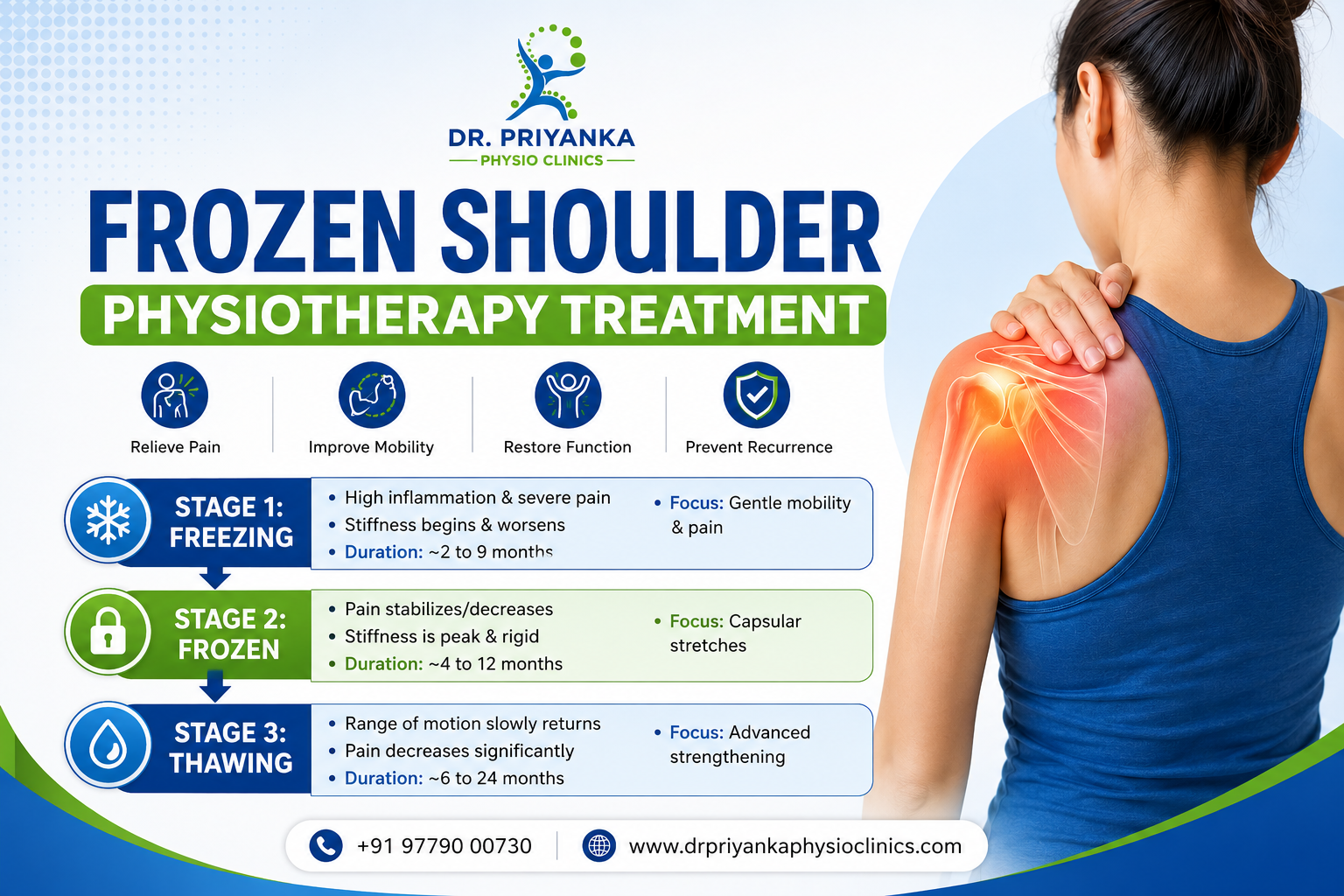
Adhesive capsulitis typically progresses through three distinct phases. Understanding these stages allows Dr. Priyanka Arora to adjust your Frozen Shoulder Physiotherapy Treatment to suit the current state of your tissue health.
During this initial phase, inflammation causes significant pain, especially with sudden movement. Pain often worsens at night. As discomfort grows, shoulder motion gradually diminishes. In this phase, Frozen Shoulder Physiotherapy Treatment focuses on gentle pain relief, gentle range-of-motion work, and preventing further loss of mobility without over-irritating the inflamed capsule.
Pain may begin to diminish slightly or plateau during this stage, but joint stiffness reaches its peak. Daily activities become extremely challenging because the capsule is at its tightest. Here, physiotherapy treatment for frozen shoulder centers on deep tissue work, joint mobilization, and targeted stretching to elongate tight capsular tissue.
In this final phase, joint restriction gradually thaws, and range of motion slowly returns. Frozen Shoulder Physiotherapy Treatment shifts focus toward progressive strengthening exercises, functional restoration, and refining biomechanics so you can return to normal daily activities confidently.
A comprehensive diagnosis ensures that your shoulder pain treatment directly targets adhesive capsulitis rather than conditions with similar symptoms, such as rotator cuff tears, bursitis, or osteoarthritis.
When you visit Dr. Priyanka Arora, the diagnostic evaluation includes:
Once an accurate clinical picture is established, Dr. Priyanka Arora designs a personalized Frozen Shoulder Physiotherapy Treatment plan aligned with your specific recovery goals.
While frozen shoulder can eventually resolve on its own over a lengthy period, leaving it untreated often leads to long-standing weakness, altered movement mechanics, and months of unnecessary suffering. Dedicated Frozen Shoulder Physiotherapy Treatment provides crucial benefits:
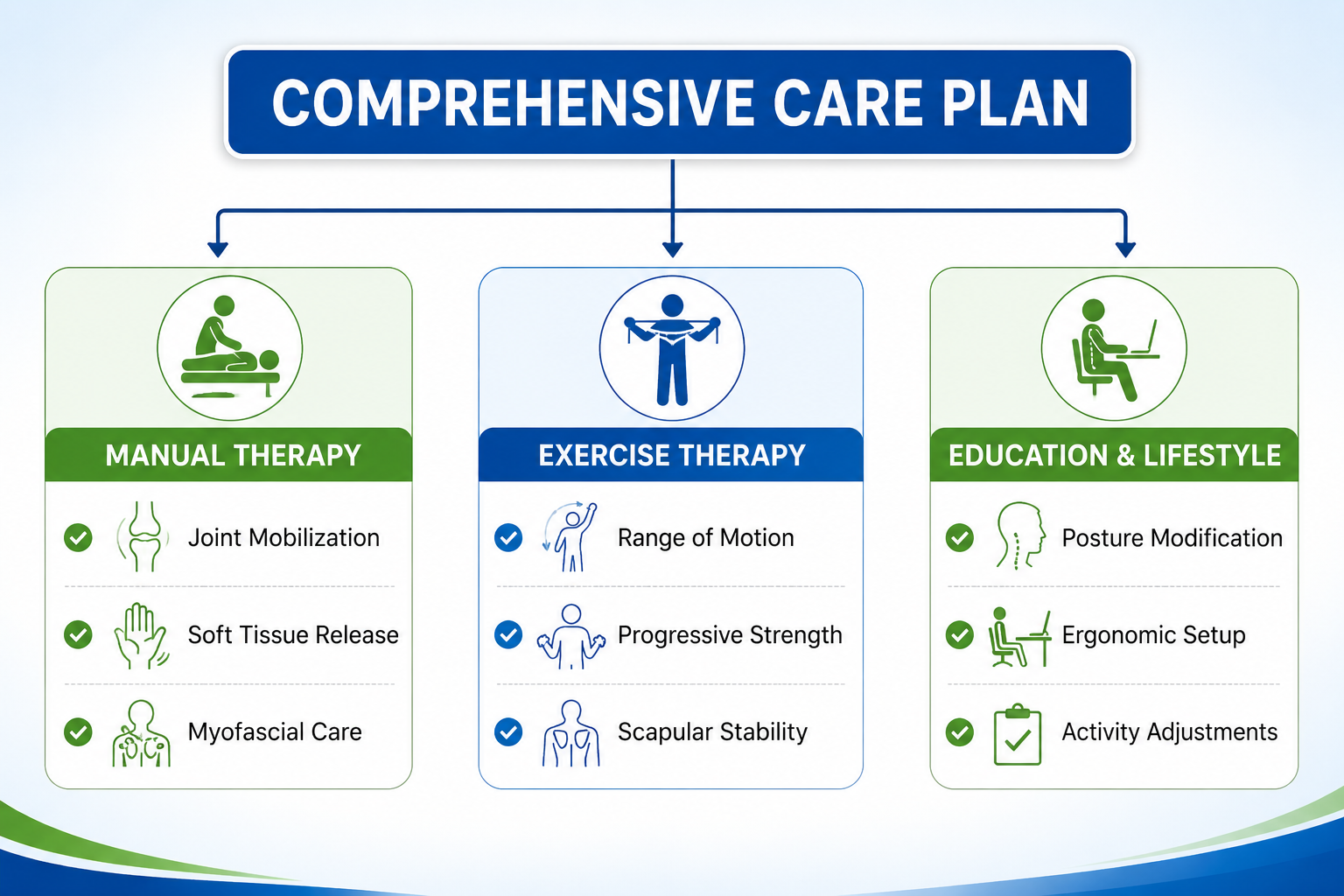
A successful frozen shoulder physiotherapy plan utilizes a combination of modalities tailored to your recovery stage. Dr. Priyanka Arora uses an evidence-informed multi-faceted clinical approach.
Targeted frozen shoulder exercises and shoulder mobility exercises form the foundation of joint restoration. These techniques elongate tight capsular structures safely.
Stand next to a table, leaning forward slightly while supporting your non-affected arm on the surface. Allow your stiff arm to dangle freely toward the floor. Gently swing the affected arm in small, controlled circles, forward and backward, and side to side. Use momentum rather than shoulder muscle force. Perform for 1–2 minutes to gently relieve capsule pressure.
Hold one end of a small towel behind your back with your unaffected arm over your shoulder. Grasp the bottom end of the towel with your affected arm behind your lower back. Gently pull upward with the top hand to pull the stiff arm upward across your back until a mild stretch is felt. Hold for 15 to 20 seconds.
Face a wall at arm’s length. Place the fingertips of your affected arm on the wall at waist level. Slowly walk your fingers up the wall like a spider, lifting your arm as high as comfortable without shrugging your shoulder upward. Pause at the top, then crawl back down. Repeat 8 to 10 times.
Hands-on techniques performed during Frozen Shoulder Physiotherapy Treatment provide therapeutic benefits that self-stretching alone cannot match.
Dr. Priyanka Arora applies specialized joint mobilization techniques—applying precise, gentle oscillatory forces directly to the shoulder capsule. These movements relieve stiffness, increase the flow of lubricating synovial fluid, and break down restrictive adhesions. Additionally, soft tissue massage and myofascial release around the chest, trapezius, and scapular muscles reduce chronic muscle guarding, making daily movement easier and far less painful.
As range of motion improves during physiotherapy for frozen shoulder, rebuilding strength around the joint becomes vital. Weakness often develops after months of guarding and immobility.
Even effective clinical care can be undermined by poor habits at home or work. Part of comprehensive Frozen Shoulder Physiotherapy Treatment involves learning how to protect your joint during recovery:
Patients often ask how quickly physiotherapy treatment for frozen shoulder produces noticeable results. Because adhesive capsulitis naturally progresses through multi-month phases, recovery is a gradual process requiring patience and consistent effort.
Adhering closely to the home exercise routine recommended by Dr. Priyanka Arora significantly accelerates your overall timeline and outcome.
You should seek a professional consultation for Frozen Shoulder Physiotherapy Treatment if:
Early assessment ensures that an effective adhesive capsulitis treatment plan begins before joint capsule tightness becomes severe.
Therapy should never cause severe, sharp, or intolerable pain. While stretching a tight capsule involves mild discomfort or a strong pulling sensation, Dr. Priyanka Arora carefully adapts all techniques to remain within your comfortable tolerance level.
While the condition may eventually thaw over one to three years on its own, going without professional care often leaves patients with lingering movement restrictions, joint weakness, and months of unnecessary pain. Guided physiotherapy for frozen shoulder speeds up functional recovery and restores healthy joint mechanics.
For optimal results, gentle mobility and stretching exercises should typically be performed 1 to 3 times daily, as recommended by your physical therapist. Short, consistent exercise sessions are far more effective than infrequent, intense workouts.
Moist heat is generally beneficial before stretching to relax tight muscles and improve tissue compliance. Ice is ideal after exercises or at the end of the day if you experience acute soreness or inflammation.
Recurrence in the same shoulder is relatively rare once full mobility and strength are restored. However, individuals with underlying risk factors like diabetes must maintain regular physical activity and proper shoulder mechanics to safeguard long-term joint health.
Frozen shoulder can significantly impact your daily life, turning routine movements like reaching, dressing, or sleeping into frustrating challenges. However, you do not have to wait out years of discomfort in silence. Through targeted Frozen Shoulder Physiotherapy Treatment, patients can safely navigate the freezing, frozen, and thawing stages with reduced pain and faster mobility recovery.
By combining gentle joint mobilizations, soft tissue release, progressive strengthening, and customized home exercises, Dr. Priyanka Arora provides a structured pathway to break the cycle of stiffness and restore full functional use of your arm. Taking action early is the key to preventing long-term joint tightness and secondary upper back strain. Schedule your evaluation with Dr. Priyanka Arora today to take the first step toward moving freely and living pain-free.